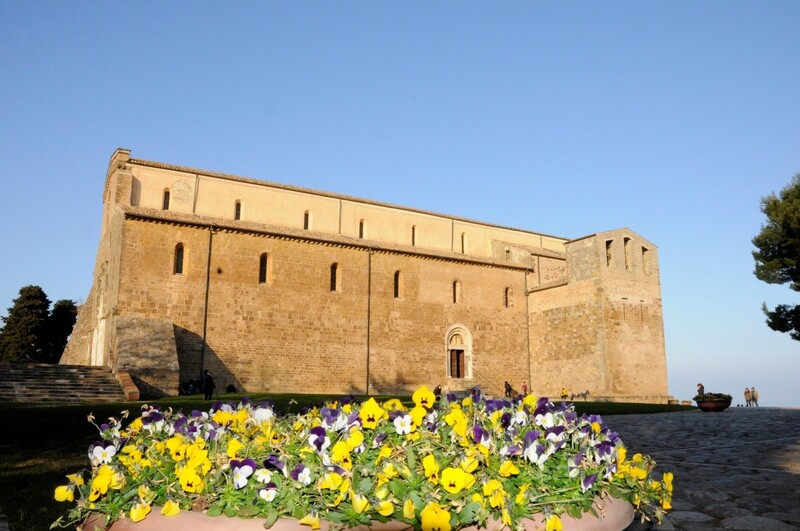
The abbey of St. John in Venus stands isolated on a promontory from which a long stretch of the Adriatic coast is dominated. The attribute “in Venere” may derive from the presence in the area of an ancient Roman temple dedicated to the deity, of which, however, no obvious traces remain. Recent archaeological excavations in the vicinity of the monument, however, have returned tombs and materials ranging from the 5th century BC to the 6th-7th centuries AD, evidence of a long human occupation of the area. The presence of a simple monastic cell is attested between the 9th and 10th centuries, while the foundation of the abbey proper is due to the will of the Theatine count Transmondo II, starting in the year 1004. Its final appearance, influenced by the Burgundian style, is the result of transformations made beginning in 1165 by Abbot Oderisio II and later ones in 1225/1230, desired by Abbot Rainaldo. Built with reddish sandstone blocks, it presents the classic layout of solid Benedictine architecture with three naves, in which, however, there is no shortage of surprising motifs (note, for example, the arches that punctuate the interior, round-arched on the right side and pointed on the left side). Absolutely noteworthy is the main portal, flanked on both sides by marble high-reliefs dating from the time of Abbot Oderisio, masterfully carved with the stories of St. John the Baptist; the lunette above, referable to the time of Abbot Rainaldo along with the archivolt, shows instead Christ Enthroned between the Madonna and St. John the Baptist, while at their feet was another scene, unfortunately mutilated, with St. Benedict in the cave, between St. Roman and another figure. Walled to the left of the portal are parts of Oderisius’ tomb, with its epitaph. The workmanship of the apses is valuable, with brick inserts forming small roundels with bichromatic geometric decoration, placed between a theory of blind arches and an overlying band worked in lozenges. Beneath the raised chancel is the crypt, scanned in bays of cross vaults supported by small columns; In the apsidal basins are interesting thirteenth-century frescoes, including one with Christ between St. Michael the Archangel and St. Nicholas of Bari (already mentioned in the Insight devoted to the Archangel), and another with Christ seated on a cosmatesque throne between the two Johns, the Baptist and the Evangelist, and Saints Peter and Paul. A St. Michael the Archangel in relief can be seen in the lunette of the right side portal, while a third portal, reassembled in 1204 using 10th-century sculptural elements in the jambs and lunette, leads into the verdant cloister with three-mullioned windows, which is the result of a 20th-century reconstruction. A small community of Passionist fathers lives in the monastery.
