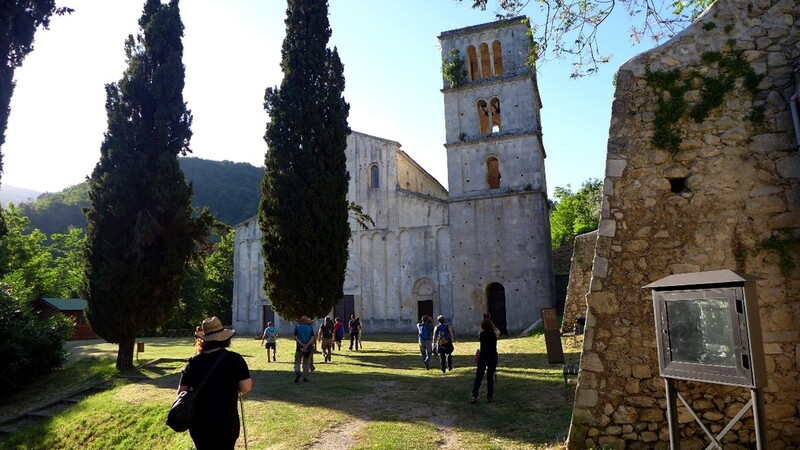
The provostry of San Liberatore a Maiella, along the verdant valley of the Alento River, was the most important Cassinese outpost in Abruzzo, directly subordinate to the abbot of Montecassino. The monastery, beyond some legendary accounts that attribute its founding to two Roman patricians or even Charlemagne, compares in documents from the 9th century onward; in particular, the Memoratorium of Abbot Bertarius describes its vast possessions, which stretched along the valleys of the Foro and Alento, and reached as far as the sea. Destroyed by an earthquake at the end of the 10th century, it was rebuilt in grandiose forms by the provost Theobald beginning in the early years after the year 1000, only to be further transformed and embellished at the behest of the famous Cassinese abbot Desiderio, who around 1080, before becoming pope under the name of Victor III, gave the monastic church the forms still visible today. In pure Romanesque style, San Liberatore constituted a model to be imitated for countless subsequent Benedictine architectures, radiating throughout the region the artistic solutions that had been adopted here; today, only the church and bell tower remain of the complex, while the monastic annexes appear to have disappeared. The grandiose building has a Lombard Romanesque layout with a tripartite facade, corresponding to three archivolted portals and three wide naves. The portals have the typical palmette ornamentation of the Cassinese matrix, but the one on the right shows two crouching, facing lions working the entire space of the architrave. The naves are divided by round arches on massive square pillars and are closed by as many apses, decorated on the outside with hanging arches, which also run across the top of the facade and side elevations. Important remains of frescoes from the second half of the 13th century remain in the central apsidal basin, recounting the legendary origin of the abbey; coeval with the frescoes, and possible to the same commission by the French abbot Bernard Ayglerio, is the marvelous cosmatesque mosaic floor, unfortunately preserved only for a portion of the nave. A few decades older is the ambo (reconstructed with the surviving fragments), made in the style of those at San Pelino in Corfinio and Santa Maria di Bominaco in the penultimate decade of the 12th century. The church also shows interventions referable to later centuries, such as the wide row of 16th-century windows in the nave and the striking sequence of buttresses on the right side, necessary to counteract the buoyancy of the ground; the roof, on the other hand, was rebuilt during 20th-century restorations.
