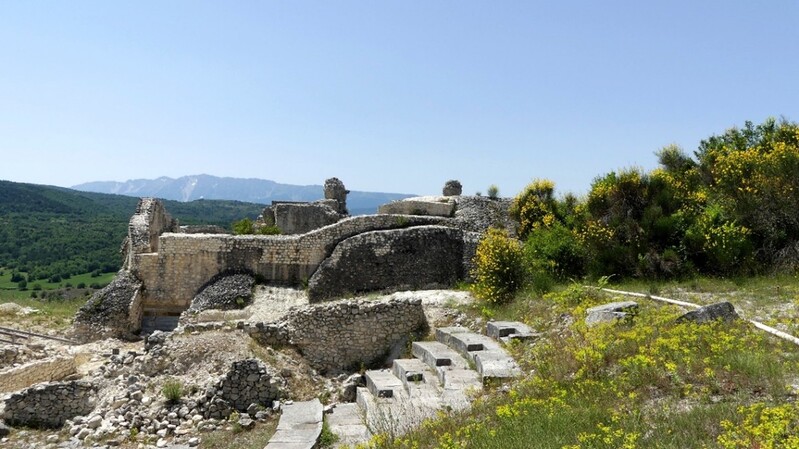
The ancient city of the Vestini people stood on a hilly relief within a wide natural basin surrounded by the Gran Sasso and Sirente ranges; it was already originally crossed by an important road axis, which would later become the Via Claudia Nova and then the Tratturo Magno. The origin of the first settlement lies around the 5th-4th centuries B.C., but the settlement was transformed into a praefectura on the basis of the urban planning canons of the Roman era in the mid-1st century B.C; the construction of the imposing city walls and the monumentalization of the site, with the building of temples and the theater, date back to the 1st century AD The city began its decline due to the earthquake of 443 AD and the population took up residence in better defensible places because of the wars and barbarian invasions following the fall of the Roman Empire. Abandonment was followed by the phase of building spoliation, the architectural elements of which can be found in many buildings in the surrounding area, starting with the medieval church of San Paolo, near the archaeological area, and ending in Prata d’Ansidonia and Bominaco. Excavations of the site, begun in the 1980s, have unearthed part of the monumental theater, the forensic area and the temple probably dedicated to Apollo, as well as cisterns, tombs and remains of civil construction, with domus with mosaic floors. Outside the city wall, of which large sections in opus capitis and the large double-arched western gate remain, a sector of archaic necropolis dating to the 7th century BC has come to light
