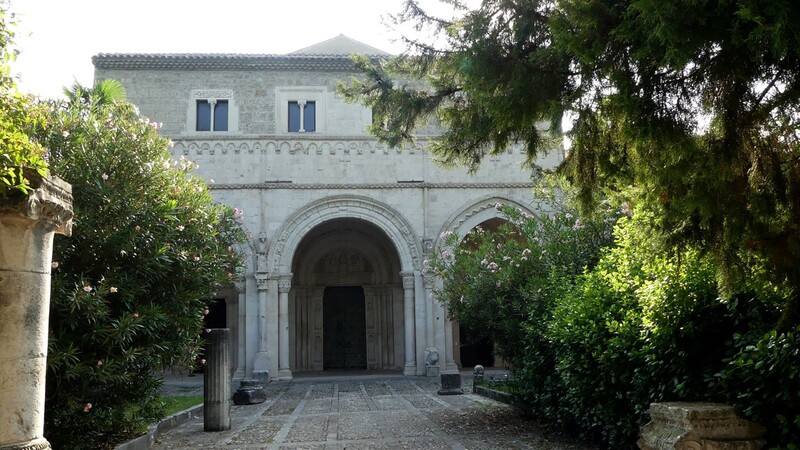
According to the famous Chronicon Casauriense, the abbey would rise on an insula Piscariae in the years around 870, following a vow made by Emperor Ludwig II during his imprisonment at the Lombard Duchy of Benevento. Ludovic himself would later donate to the monastery a relic of St. Clement, received directly from the hands of Pope Adrian II, from which the complex drew its title. Destroyed by the Saracens around 911 and rebuilt in the 11th century, St. Clement’s soon had to suffer the interference of the Normans, who sacked and devastated it; it was to the influential abbot Leonate that the abbey’s political and religious power was reaffirmed, including through the reconstruction of the complex, which began in 1176. Leonate, however, failed to see the completion of the work he undertook, due to his death that occurred in 1182. The monument is one of the best known and most significant of Abruzzo’s Romanesque art and has come down to the present day, in the forms conferred by Leonate, thanks to a long series of restorations. The church is characterized by a large three-arched portico in front of the facade, with finely carved capitals and archivolts. A true masterpiece is the main portal (fig. p. preceding), which bears on its jambs four sovereigns holding the privileges granted to the abbey and shows carved in the architrave the story of the acquisition of the rights over the Insula Piscariae by Emperor Ludovico and the foundation of the primitive abbey of SS. Trinity (on the right side of the lintel), and the transport of the relics of St. Clement the Pope on the back of a donkey from Rome (on the left side); in the lunette, on the other hand, Leonate is seen caught in the act of donating the church to the saint. The large bronze wings of the central doorway, commissioned by Abbot Joel and composed of 70 panels (unfortunately many are missing), recalled all the castles owned by the abbey. Above the portico is an oratory that Abbot Leonate wished to dedicate to the Holy Cross, St. Michael the Archangel, and St. Thomas Becket. The interior, divided into three naves with a single apse closing the central one, is structured on two different levels of elevation between the hall and chancel because of the presence of the crypt, which some believe is the only surviving part of the original construction. Striking is the extraordinary workmanship of the stone ambo with a quadrangular case, dating from the late 12th century, with large, finely crafted openwork relief flowers, an absolute masterpiece of Abruzzo medieval sculpture (fig. right); opposite is an elegant candelabrum for the Easter candle, whose precious cosmatesque mosaic decorations on the lantern make it date from the 1200s. The altar is an early Christian sarcophagus from the 4th century, surmounted by a valuable 15th-century ciborium worked on all faces, which also recalls the story of the foundation of the abbey already seen in the portal.Inside the altar was found a marble cinerary urn from the Roman period, now displayed in the right wing of the transept, which some believe is the one used to transport the relics of St. Clement.
