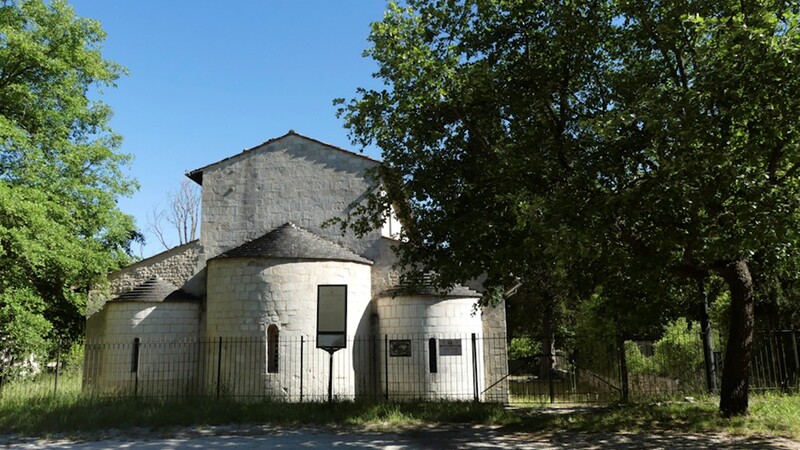
The inscription on the lintel of the portal, A REGE DESIDERIO FVNDATA – MILLENO CENTENO RENOVATA (founded by the Lombard king Desiderius, renewed in 1100) would like to date the foundation of the Benedictine monastery to the will of the Lombard king Desiderius, but in fact the building of the complex is even earlier, being included among the appurtenances of San Vincenzo al Volturno already in a document of 752, while Desiderius was king from 756: evidently the stone-mason wanted to attribute greater nobility to the building, tying its foundation to the will of a king. Be that as it may, the church, which stands in splendid solitude on the left bank of the Tirino River, was rebuilt in the 12th century; the structure is the classical one with three naves and three apses, but nothing remains of the monastic annexes, which were developed on the right side. The inspirational model for the rebuilding of San Pietro ad Oratorium was the monastic church of San Liberatore a Maiella, and the renovation work, precisely dated on the portal to 1100, is confirmed by the palmette decoration of the portal archivolt, a motif first introduced in Abruzzo precisely at San Liberatore a Maiella, where it had been used just a few decades earlier (c. 1070). The portal of St. Peter’s, however, in addition to the aforementioned 12th-century decoration, shows signs of a second intervention, consisting of the replacement of the original jambs with two new, richly carved jambs and the placement of two figures on either side of the portal, depicting St. Vincent the Deacon and the prophet David, which was implemented by sculptors who arrived from the San Clemente a Casauria site after 1180. Absolutely singular is the presence, in the left corners of the facade, of an erratic stone ashlar, mounted upside down, on which is the “magic square” of SATOR, the five famous words that constitute one of the most famous and mysterious palindromes in history. The interior, divided into three naves divided by arcades resting on simple pillars, holds on the back arch and in the apsidal basin of the nave a cycle of Byzantine frescoes that are among the oldest in the region (12th cent.) and a precious 13th-century ciborium to surmount the altar. Above the large arch that identifies the apsidal closure is a Majestas Domini with Christ between angels and evangelists with, on the edge of the arch, the 24 seniors of the Apocalypse. In the apsidal basin, on the other hand, the figures of Saints Peter and Paul are recognizable, but here the frescoes have large gaps; below are six Benedictine saints enclosed in painted niches on either side of the apsidal lancet window. The figures depicted are still fixed in the static nature of Byzantine painting and are painted with a singular chromaticism whose band oscillates from red to brown to sienna, with white and rare brushstrokes of green.In front of the frescoes stands out the precious thirteenth-century ciborium, embellished (a unique case in Abruzzo), at the intersections of the ogival arches by the insertion of green and turquoise majolica tiles.
